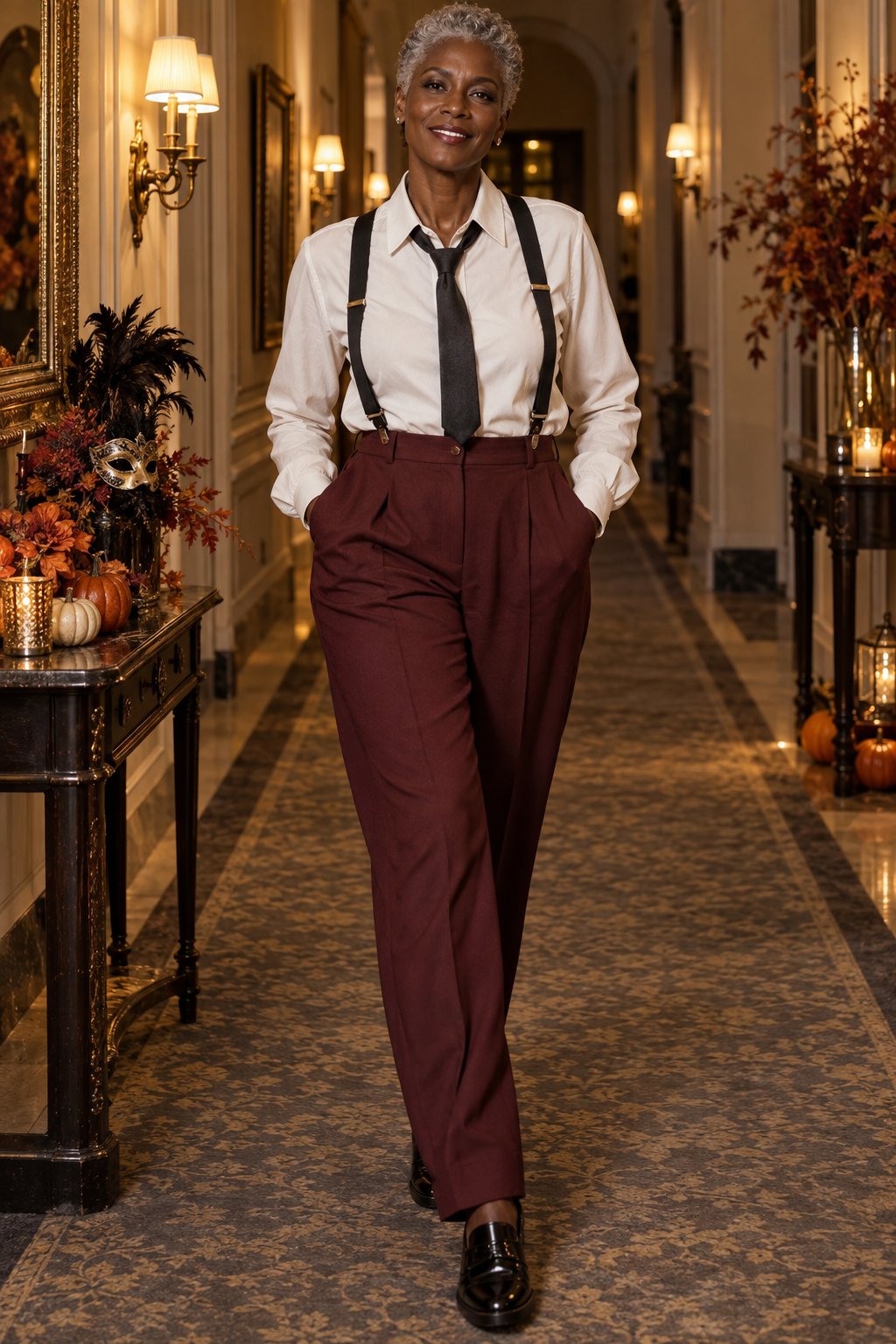
The one rule: equal silhouette weight
A couple costume works when both silhouettes are equally specific. If one person is a full character with a hat, a coat, and makeup, and the other is a polo shirt, the photo will always read as one costume and one guest.
The practical version of the rule:
- If one wears a wig, the other wears a hat or deliberately styled hair.
- If one has face paint, the other has one anchor detail: a dark lip, a drawn brow, or a scar.
- If one carries the big prop, the other carries a second prop of roughly the same size.
The exception is deliberate: a handler-and-creature joke can work, but decide it on purpose, not by default.


The forty pairings
Classic pairs (10): the gothic power couple (pinstripe suit and column black gown), vampire lord and vampiress, angel and devil, vampire and vampire hunter, pirate captain and first mate, detective and cat burglar, mad scientist and lab assistant, mortician and widow, ringmaster and fortune teller, western outlaw and saloon singer.
Movie-era pairs (10): retro spy duo in dinner jackets, 1970s disco pair, 1980s aerobics instructors, 1920s silent-film stars, tailored mob pair, space commander and alien diplomat, noir reporter and femme fatale, rock star and roadie, two heroes from the same league, fantasy ranger and rogue.
Funny pairs (10): plug and socket (built in felt, not body paint), peanut butter and jelly, salt and pepper, a cereal killer with the last box as the victim, static cling, one partner as a GPS voice and the other as the missed exit, the airplane safety-card couple, shoulder cat and cat owner, tourist and landmark, "error 404" and the backup drive.
Matched sets (10): two crayons, two playing cards, twin devils under red light, matching skeletons, coordinated aliens, two troopers from a generic numbered legion, a coven of two plus a hat for the dog, partner wrestlers in retro masks, two diner waitresses from different decades, backup singers for a band that never existed.
Three of these have full build guides: the pinstripe half of the gothic pair in the Gomez breakdown, the column-gown half in the Morticia guide, and the squad-scale versions in the group costumes lineup.

Not sure yours will come out right? Preview ten event-portrait styles of you in about three minutes.
See a previewBuild tiers for two
| Tier | What you buy | What carries the costume |
|---|---|---|
| Closet | Nothing, or under ten dollars | A matching color story plus one shared prop |
| Thrift | Two statement pieces | Silhouette contrast: boxy against fitted |
| One purchase | Two wigs or two hats | Hair symmetry: same era for both partners |
| Rental or custom | One hero piece for one partner | Equal-strength makeup for the other partner |
Buy both wigs from the same brand line so the fiber matches on camera. Mismatched synthetic hair is the most common flaw in otherwise good couple photos.

Makeup and props ladder for pairs
- Agree on the era and the light. A matte vintage face next to a glossy modern face reads as two different photos on one couch.
- Same-intensity rule: if one face has full paint, the other needs at least a strong lip or brow. Nothing between.
- One prop per person, sized within a hand-span of each other, so neither silhouette reads as an accessory.
- Do the pair test in one mirror for two minutes before the party. The pair test catches imbalance that solo mirror checks always miss.


Posing: frames that flatter two costumes
- Back-to-back, heads turned toward camera. Works for any pair with contrasting silhouettes and keeps both costumes visible in one frame.
- Walking toward the camera, hand in hand. Shoot bursts; the mid-stride frame with both coats moving is the keeper.
- The height stack. The taller partner sits, the shorter partner stands behind with hands on their partner's shoulders. Levels the height difference that standing frames exaggerate.
- The shared-prop frame. Both hands on one object: a steering wheel, a door handle, a lantern. Gives the hands a job and a natural reason to lean in.
- Profile to profile. Face each other in profile, one step apart, shot from the side. Best frame for dramatic makeup because both faces stay readable.
Lighting: one source at 45 degrees serves pairs the same as solos. Both faces turn slightly toward it, and the nearer partner drops their chin half an inch so neither face steals the key light.
What goes wrong with couples costumes
- The inside joke. A pairing from your private history is invisible to everyone else. If it needs a sentence of setup, it lands for nobody at the party.
- Mismatched commitment. One partner orders a full costume; the other plans to figure it out on Thursday. Agree on the tier from the build table first, in writing if necessary.
- The couple costume that photographs as one blob. Matching colors head to toe removes the boundary between you. Keep one contrasting element: a collar, a hat, a different fabric.
- Skipping the seated frame. Standing couple shots at arm's-length phone distance flatten both costumes into one block. Sit down for at least one frame.
Missed your window? Upload five selfies. Get a polished portrait back in about three minutes.
Try the generatorThe AI route for couples
Honest limits first: multi-person AI generation where two real people both look like themselves is not reliable yet, so this page does not pretend otherwise. What works: each partner generates a solo costume preview from their own 5 to 15 selfies, previews land in about 3 minutes watermarked and free, and HD downloads are paid if you want them, from $15 for 5 photos. The catalog runs 107 looks across 6 categories, with seasonal costume-inspired and character-inspired styles in the events category under generic names. Upload only photos of yourself. Compare previews on a shared board and buy the costumes you both actually liked.
For the photo half of the night, the Halloween photoshoot ideas guide covers two-person scene setups. If you would rather browse beyond pairs, the main Halloween costume ideas hub sorts fifty-plus looks by venue and effort.