For most jobs in the United States, leave your photo off the resume. Use the space for evidence of what you can do, and keep your professional portrait on LinkedIn, a portfolio or a personal website. Add a photo only when the application explicitly requests one, the role itself is appearance-based, or you are applying in a market where local convention clearly expects it.
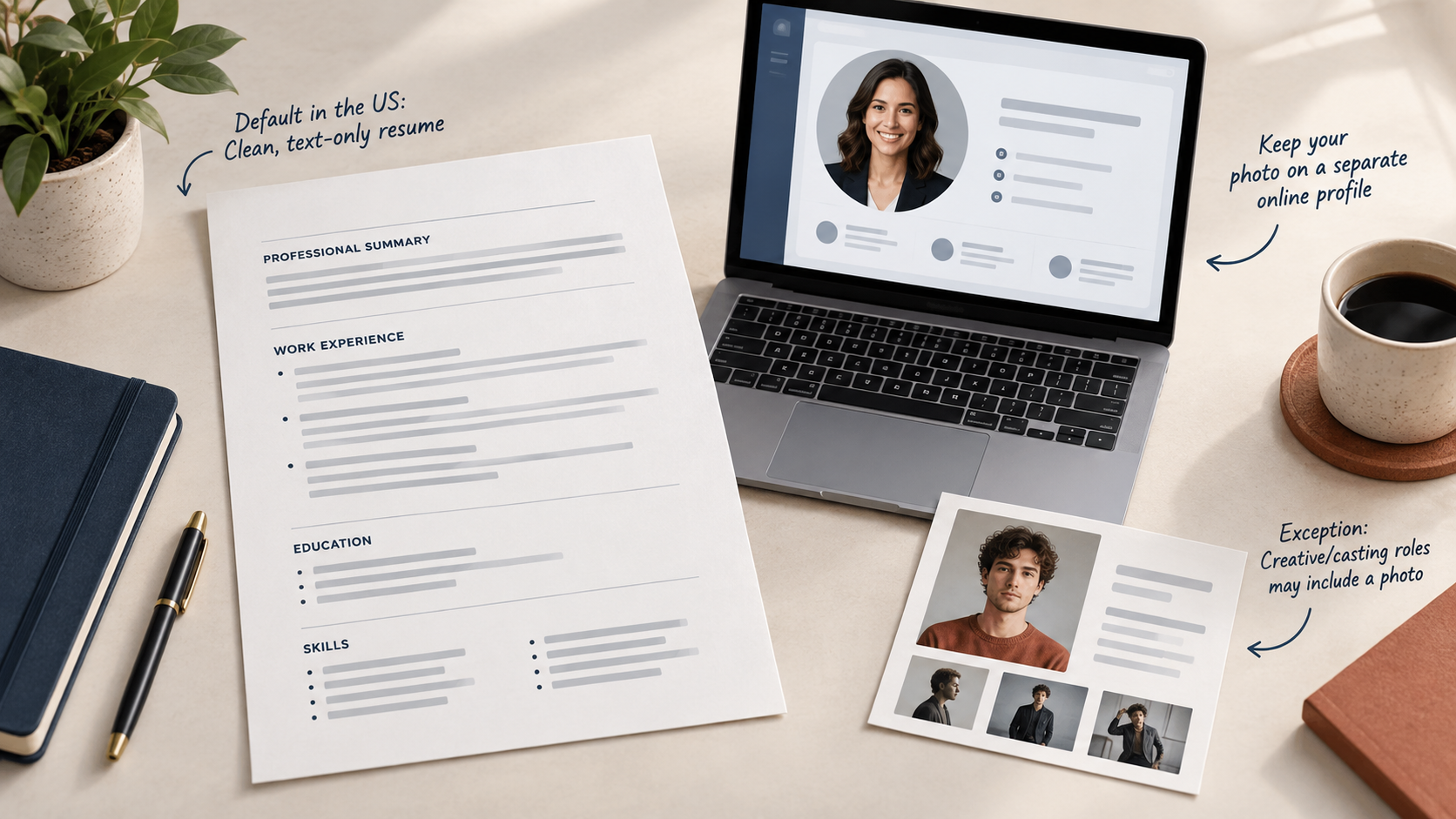
The default US path keeps qualifications on the resume and the portrait on a separate professional profile.
The fast decision tree
Are you applying for a typical US office, technical, service, education, healthcare or government job?
Leave the photo off.
Does the employer's official application ask for a photograph for a legitimate role-specific reason?
Follow the instructions, but keep the photo separate from the resume unless the application says otherwise.
Are you applying for acting, modeling or another role where a current likeness is part of the professional material?
Use the format expected by that industry, such as a headshot, comp card or portfolio.
Are you applying outside the United States?
Check the country and employer convention before reusing a US resume.
Why the US default is no photo
A resume is meant to communicate qualifications: experience, skills, education, licenses and measurable results. A portrait adds information that is usually unrelated to whether you can perform the job.
The EEOC advises employers not to request an applicant photograph because pre-employment inquiries connected to protected characteristics may be evidence of discriminatory intent.1 That guidance is written for employers, but it explains why many US hiring processes deliberately keep photographs out of the initial screen.
USAJOBS explicitly tells federal applicants to leave photos of themselves out of their resumes.2 Federal applications have their own detailed rules, so always read the announcement rather than copying a private-sector template.
The practical result is simple: when a photo is not requested, omitting it is the safer and more conventional US choice.
What to put in that space instead
Use the top third of the page for information that earns the next ten seconds of attention:
- your name and reliable contact details;
- the role or professional direction you are targeting;
- a short summary only when it adds evidence;
- two or three high-value skills tied to the job;
- recent achievements with numbers or clear outcomes;
- a LinkedIn or portfolio URL when it is relevant and current.
For a strong online portrait, use a dedicated LinkedIn profile picture rather than embedding the image inside the document. This gives recruiters a choice to view the profile while keeping the resume focused and easier to parse.
The real exceptions
Acting and modeling
These fields use visual materials as part of the application. A headshot, full-body image or model comp card may be expected, but it is usually its own asset rather than decoration added to a conventional resume.
UCLA's Career Center gives the practical exception: acting or modeling roles, or countries where a photo is customary.3 Follow the role's submission instructions precisely. For modeling, our model headshot guide explains how to prepare a role-specific portrait.
Creative portfolios and personal websites
A designer, photographer, speaker, founder or consultant may benefit from a recognizable professional portrait on a portfolio site. Keep the conventional resume focused on qualifications, then link to the portfolio so the richer page can introduce the portrait in context.
Employer-requested identification
If an employer requests identification or security materials later, do not add them to the initial resume. Use the employer's secure, official process and provide only what it requests at the appropriate stage.
International applications
Before reusing this US-first advice abroad, check the destination market and the specific organization. Do not assume one country's template belongs in another country's hiring process.
What about applicant tracking systems?
Simple formatting helps both software and human readers. A headshot, text box or decorative sidebar can consume space and complicate extraction without adding job evidence.
Keep essential information in ordinary text with clear headings. Use a readable font, consistent dates and familiar section names. Export to the requested file type, then reopen the document to confirm that nothing moved.
This is a formatting argument, not a guarantee that every system rejects photographs. The more important point is that the photo is usually irrelevant to the US hiring decision and can be kept on a separate profile.
If you already have a photo on your resume
You do not need to redesign everything. Make a clean duplicate:
- Remove the photo and its frame.
- Move your name and contact details into the freed space.
- Add one relevant achievement or restore white space.
- Check that the resume still fits the expected length.
- Export a fresh PDF with a professional filename.
Then update the separate profile photo if it no longer represents you. The professional headshot guide covers expression, crop and background choices for that use.
How to choose the separate professional photo
The best profile portrait is current, recognizable and appropriate for the work context. It does not need to be stiff.
- Use a clear head-and-shoulders crop.
- Keep the eyes visible at thumbnail size.
- Choose a simple background or enough separation from it.
- Wear what makes sense one level around the role's everyday formality.
- Avoid turning the profile picture into a miniature resume full of text.
If you need a dedicated resume-profile portrait rather than a photo inside the document, see MyPhotoAI's resume photo options.
Common questions
Can a photo help me stand out?
It can make the page visually different, but standing out is not the same as communicating fit. Strong evidence, clear hierarchy and a tailored first page are more useful signals for most US roles.
Should I include my LinkedIn URL instead?
Yes, when the profile is complete, current and relevant. Use a clean custom URL if available and make sure the experience dates match the resume.
What if the job posting asks for a headshot?
Confirm that the request is legitimate and role-relevant. Follow the official application instructions, and provide the image as a separate file if that is what the employer requests.
Does this apply to academic CVs?
US academic CVs are longer and structured differently from resumes, but a portrait is still not a standard requirement. Follow the institution and discipline's instructions.
The default to remember
For an ordinary US application, submit a focused resume without a portrait. Put the professional photo where it has context: a LinkedIn profile, portfolio, speaker page or role-specific visual application.


