Your safest business-casual headshot outfit is a solid mid-tone top with a clean neckline, one optional layer and minimal reflective detail. It should feel polished enough for your industry and relaxed enough to resemble what you actually wear.
The trick most wardrobe lists miss: the camera may show only the top third of the outfit. Choose the full look for confidence and posture, then judge the neckline, collar and shoulder area as the final image.
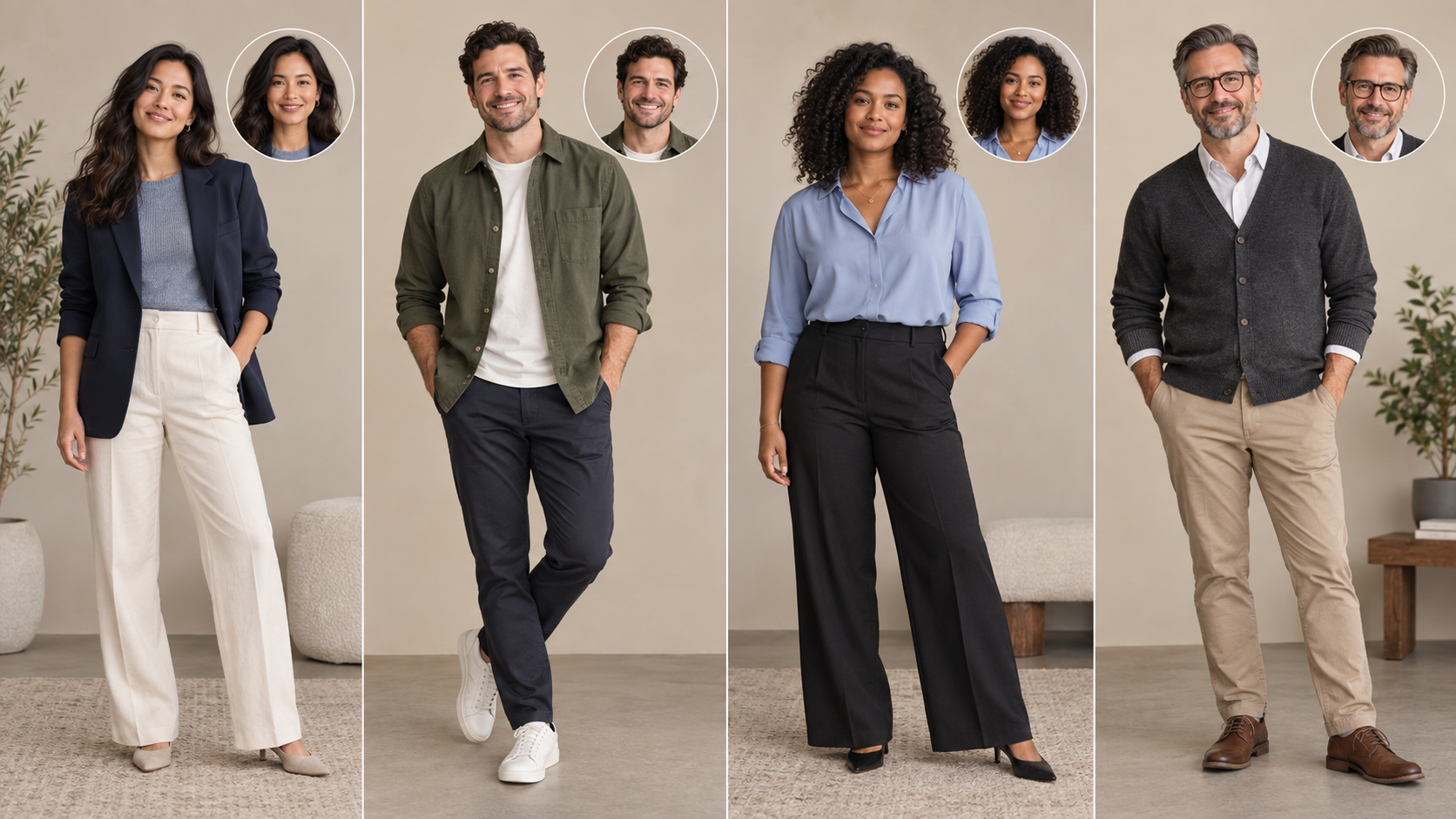
Editorial lookbook. The full outfits are paired with the crop a profile viewer will actually see.
Choose your formality in 15 seconds
Use this simple slider:
- More formal: client-facing finance, law, leadership announcements or conservative company directories. Add a structured blazer or jacket.
- Middle: consulting, sales, education, healthcare administration and most LinkedIn profiles. Use a blouse, collared shirt, fine knit or polished overshirt.
- More relaxed: design, engineering, startups and creator-led brands. A premium crew neck, cardigan or chore jacket can work.
The University of Illinois Career Center’s attire guidance describes business casual as less formal than a suit and built from polished separates rather than one prescribed uniform.1 Your organization’s culture and the destination of the photo still decide the final level.
Look 1: blazer + soft knit
Full outfit: navy or charcoal blazer, muted knit top, tailored trousers and simple shoes.
What survives the crop: a strong shoulder line and a soft, uncluttered neckline.
Best for: managers, consultants, sales teams and anyone who wants authority without full business-formal styling.
Easy substitutions: swap the blazer for an unstructured jacket; swap the knit for a matte crew neck or shell.
Look 2: overshirt + clean crew neck
Full outfit: olive, navy or tan overshirt over a cream, gray or black crew neck.
What survives the crop: texture and an open vertical line without the stiffness of a suit jacket.
Best for: product, engineering, architecture, creative operations and startup profiles.
Easy substitutions: use a chore jacket, lightweight bomber without logos or a substantial cardigan.
Look 3: blouse + minimal jewelry
Full outfit: soft blue, deep green, burgundy or warm neutral blouse with tailored trousers or a skirt.
What survives the crop: color near the face and a clean neckline.
Best for: approachable leadership, education, healthcare, customer success and professional services.
Easy substitutions: choose a knit shell, modest V-neck or collarless top. Keep jewelry small enough that it supports rather than dominates the face.
Look 4: cardigan + collared shirt
Full outfit: charcoal or navy cardigan over a pale blue or soft white collared shirt.
What survives the crop: layered contrast and a familiar, accessible professional signal.
Best for: academics, advisors, non-profit teams and people whose brand is calm expertise.
Easy substitutions: try a quarter zip over a collared shirt or a textured blazer over a simple tee.
Color: use contrast, not rules about skin tone
Hold the clothing near your face in the light you will use. You want separation between hair, clothing and background without making the shirt the brightest object in the frame.
Useful starting points include navy, slate, forest green, rust, burgundy, muted blue, cream and charcoal. A bright company color can work as an accent, but avoid turning the portrait into a uniform unless that is intentional.
Mercer University’s portrait guide recommends solid neutral colors and simple accessories, while warning that narrow stripes and fine patterns can produce moiré in digital images.2
Necklines and collars matter more than trousers
The University of Kansas portrait guidance notes that a close crop can make a very low neckline disappear and can cut off long necklaces.3
Before the session, open your phone camera, switch to portrait orientation and crop from mid-chest upward. Check:
- Does the neckline still look intentional?
- Is the collar sitting evenly?
- Do jacket lapels frame the face?
- Is an undershirt peeking out?
- Does a necklace end awkwardly at the crop?
This ten-second test prevents most wardrobe surprises.
Patterns, texture and fabric
Texture is useful; tiny repetition is risky. Fine checks, narrow stripes and close herringbone can create interference patterns on camera. Prefer solids, broad patterns or fabric texture that remains calm from a distance.
Choose fabric that can survive sitting, travel and warm lights. Steam or press the visible upper half even if the full outfit will not appear. Keep a lint roller nearby for dark knits and jackets.
What about white and black?
Both can work. The problem is not the color itself; it is whether the camera retains detail.
- White can become the brightest area and lose folds under strong light.
- Black can merge into a dark background and lose texture.
- Mid-tones are forgiving because they preserve shape across more lighting conditions.
Take a test frame against the intended background. If the garment turns into one flat block, adjust the light, background or color.
Build two versions, not ten
Bring one reliable base and one layer. Photograph:
- Base only.
- Base plus jacket, overshirt or cardigan.
- One optional color or accessory change.
That creates enough variety for LinkedIn, your team page and speaking profiles without turning the session into a costume change.
For expression, use the quick drills in how to smile for photos. For framing and polish, see the full professional headshot guide.
Screenshot this packing list
- One solid mid-tone top
- One structured or textured layer
- A backup top with a different neckline
- Simple jewelry or watch
- Lint roller
- Small steamer or wrinkle-release plan
- Neutral underlayer
- Hair and makeup touch-up items
The 30-second social version
If this article becomes a Reel, Short or carousel, the script is simple:
- Show the full outfit.
- Cut instantly to the headshot crop.
- Point out what remains: neckline, shoulders, color and jewelry.
- Replace one distracting element.
- Show the improved crop.
That is also how to judge your own options: not “Is this a good outfit?” but “Does the top third make the right promise?”
When you are ready to test different professional directions, use MyPhotoAI to explore headshot looks before committing to a single wardrobe mood.
FAQ
Are jeans business casual?
Sometimes, but they rarely appear in a conventional headshot crop. Let your industry and the full-session brief decide.
Do I need a blazer?
No. A cardigan, overshirt, collared shirt, blouse or structured knit can create enough polish.
Can I wear a pattern?
Yes, when it is broad and visually quiet. Test small checks and narrow stripes on camera for moiré.
What if my company has a dress code?
Follow it, then choose the version that still looks natural on you. A recognizable portrait beats a costume.


